We are currently open! 12:34:21PM
Our Services



✖


A blocked drain can be deceptively simple. Water stops flowing, a plumber clears the obstruction, and everything appears normal again. But what happens when the blockage returns a few days or weeks later?
That is where the difference between traditional drain clearing and CCTV Drain Inspection in Broadmeadows becomes important. Clearing a blockage can restore flow, but it does not necessarily explain why the drain blocked in the first place. Tree roots, cracked pipes, collapsed sections, grease buildup, displaced joints and damaged sewer lines can continue causing problems beneath the ground.
For homeowners dealing with Blocked Drains in Broadmeadows, understanding when to clear a blockage and when to investigate the underlying pipe condition can prevent repeated call-outs and unnecessary repair work.
This CCTV Drain Inspection Guide explains how camera inspections work, what they can reveal, when traditional drain cleaning is enough and when advanced diagnostics provide a much clearer picture of the real problem.
Traditional Drain Cleaning focuses primarily on restoring water flow. Depending on the nature and location of the obstruction, a plumber may use mechanical drain equipment, high-pressure water jetting or other appropriate methods to break apart and remove accumulated material.
This can be exactly what is needed when the cause is a straightforward blockage.
For example, a kitchen sink may stop draining because grease and food residue have accumulated inside the pipe. Once the material is removed, normal drainage may return and the issue may not come back.
A camera inspection takes a different approach.
Instead of concentrating only on removing the obstruction, CCTV Inspection allows a plumber to examine the interior of the pipe using a small waterproof camera. The camera travels through accessible sections of the drainage system and transmits images that can help identify the location and nature of a problem.
The two methods therefore answer different questions:
In many real-world situations, the most effective approach is not choosing one method over the other. It is using them in the correct sequence.
One of the most common misunderstandings about blocked drains is assuming that restored flow means the underlying problem has disappeared.
Imagine a household experiencing a slow bathroom drain. A plumber clears a buildup and the water begins flowing normally.
Several weeks later, the same drain becomes slow again.
The repeated blockage is useful information.
It suggests that something may still be contributing to the restriction. The cause could be recurring buildup, poor pipe gradient, root intrusion, a damaged section or another physical problem within the drainage system.
Continuing to clear the same obstruction without investigating the reason for recurrence can become an expensive cycle.
This is where advanced drain diagnostics can provide greater value. Rather than repeatedly treating the symptom, an inspection can help determine whether there is an underlying defect that needs a different solution.
A professional CCTV Drain Inspection Guide should start with understanding what the inspection is intended to establish.
The plumber generally needs to know:
Once the appropriate access point has been identified, a specialist inspection camera can be introduced into the drainage line.
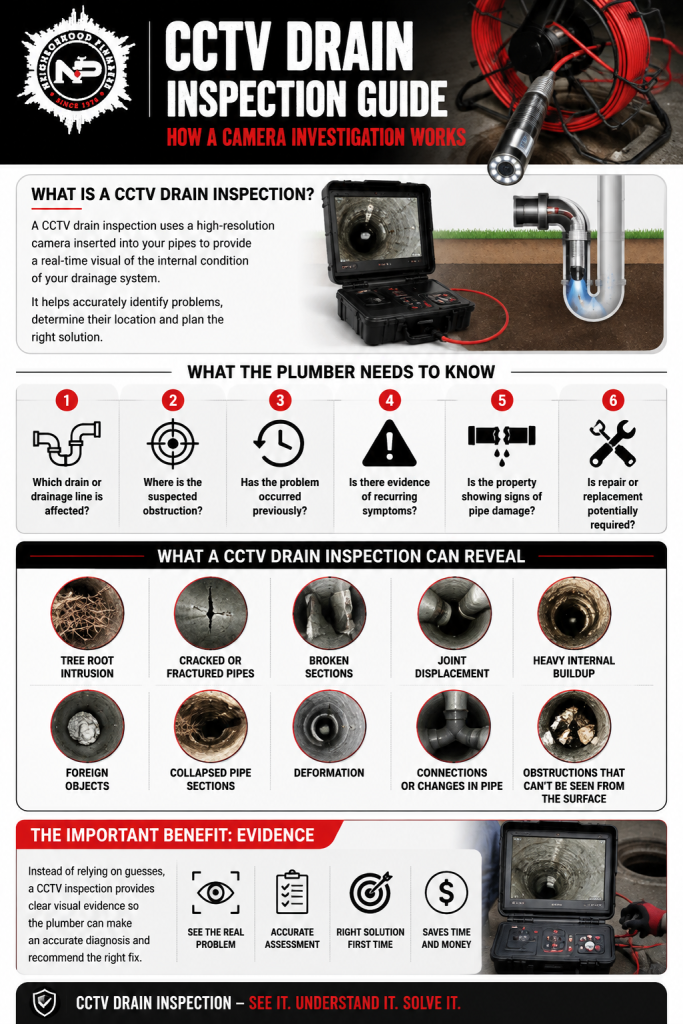
The camera provides a visual view of the internal pipe condition. Depending on access, pipe configuration and the equipment used, the inspection may reveal issues such as:
The important benefit is evidence.
Instead of relying entirely on assumptions about what might be underground, the plumber can make an assessment based on what is actually visible inside the drainage system.
Sewer Pipes can deteriorate for different reasons, and the symptoms on the surface do not always reveal the cause.
A recurring blockage, for example, could result from roots entering through a damaged joint. Removing the roots may restore flow temporarily, but if the entry point remains open, the problem may return.
Similarly, a pipe can have a structural defect that creates a location where waste material repeatedly catches.
A CCTV camera can help identify these conditions.
Tree roots naturally seek moisture. If a drainage pipe has a compromised joint or opening, roots can enter and grow inside the pipe.
A blockage caused by roots may respond to mechanical removal or high-pressure cleaning, but recurring root intrusion may indicate that the pipe itself needs attention.
A damaged pipe may continue carrying water for some time before symptoms become severe.
Cracks can allow surrounding soil or other material to enter the pipe and contribute to recurring restrictions. A camera inspection can help identify visible damage and establish whether further investigation or repair is appropriate.
Older or poorly aligned drainage systems can develop displaced joints. Even a relatively small change in alignment can create a point where debris accumulates.
Without viewing the inside of the pipe, it may be difficult to distinguish this from an ordinary blockage.
Traditional diagnostic methods often rely on symptoms, access points and the plumber’s experience.
That experience remains extremely valuable.
However, non-invasive plumbing inspections can add another layer of information without requiring immediate excavation or the removal of large sections of property.
This matters because drainage systems are frequently located beneath:
If a drainage problem can be located more precisely before excavation begins, homeowners may have a clearer understanding of what work is actually necessary.
That does not mean CCTV eliminates the need for excavation in every case. If a pipe is structurally damaged, physical access may still be required for repair or replacement.
The advantage is that the investigation can help determine where the problem is and what type of problem is present before disruptive work is undertaken.
CCTV is useful, but it should not be treated as necessary for every minor blockage.
Consider a household where a bathroom basin has recently become slow. There is no history of recurring blockages, there are no unusual smells and other fixtures are draining normally.
A straightforward obstruction may be the most likely explanation.
In that situation, appropriate Drain Cleaning may solve the problem without requiring an extensive investigation.
The key is to look at the pattern.
A one-off blockage and a repeatedly blocked drain should not necessarily be approached in exactly the same way.
A camera inspection becomes more useful when the symptoms suggest something beyond a simple obstruction.
Consider investigating further when:
Repeated blockages are one of the strongest reasons to investigate the drainage line itself.
If flow improves immediately after cleaning but deteriorates again soon afterwards, the obstruction may be a symptom of a deeper issue.
If toilets, showers, sinks or other fixtures begin showing drainage problems at the same time, the issue may involve a shared section of the drainage system.
Persistent odours can sometimes indicate drainage problems that require further investigation, although smells can have several causes and should not automatically be interpreted as evidence of pipe damage.
Signs such as recurring blockages, unusual wet areas or unexplained drainage problems can justify a closer assessment.
Before undertaking substantial excavation or pipe replacement, establishing the location and condition of the affected section can help inform the repair strategy.
One of the biggest advantages of camera-based investigation is the potential for a more accurate drain assessment.
Suppose a homeowner is told that a buried drainage pipe may need replacement because of recurring blockages.
That is a significant decision.
Before committing to extensive excavation, it can be useful to establish whether the problem is actually caused by a collapsed section, a root intrusion, a displaced joint or something that can be treated without replacing the entire line.
A camera inspection does not guarantee that every defect will be visible or that every repair decision will be straightforward. Pipe access, water levels, deposits, camera limitations and the physical condition of the line can affect what can be observed.
Nevertheless, visual evidence can substantially improve decision-making compared with guessing based only on symptoms.
Consider a Broadmeadows homeowner who experiences a blocked outdoor drain several times over the course of a year.
Each time, the obstruction is removed and drainage improves.
Initially, traditional clearing may be entirely reasonable.
But after repeated occurrences, the pattern changes the diagnostic picture.
A CCTV inspection could reveal roots entering through a damaged section of the pipe. In that situation, simply clearing the roots repeatedly treats the immediate obstruction but leaves the entry point unresolved.
The appropriate long-term solution may involve repairing the affected section rather than repeatedly clearing the same blockage.
This is an important distinction between symptom management and problem identification.
Different causes require different approaches. Grease, roots, foreign objects and structural pipe defects should not automatically be treated as identical problems.
If a drain repeatedly blocks, keeping the same treatment strategy without considering the underlying cause can increase long-term costs.
A camera inspection is an investigative tool. It does not automatically mean that excavation or replacement is required.
The purpose is to understand the condition of the pipe so that an appropriate response can be considered.
Early investigation can sometimes provide more options than waiting until a drainage line becomes severely damaged or inaccessible.
Replacing or excavating a pipe based solely on assumptions can create unnecessary disruption. Diagnosis should come before major remedial work whenever practical.
If you are dealing with Blocked Drains Broadmeadows, start by documenting the symptoms.
Note:
This information can help a plumber understand the history before beginning the assessment.
If the problem is recurring, ask what evidence supports the recommended repair.
A good diagnostic discussion should explain what has been observed, what remains uncertain and why a particular course of action is being recommended.
That transparency is especially important when the proposed work involves excavation, replacement of Sewer Pipes or significant property disruption.
A practical decision-making framework is simple.
One-off, straightforward blockage:
Traditional clearing may be appropriate.
Recurring blockage:
Consider investigating the cause.
Multiple affected fixtures:
A broader drainage assessment may be warranted.
Suspected root intrusion:
CCTV can help establish the location and extent of the problem.
Suspected structural damage:
Camera inspection can provide useful evidence before major repair work.
Major drain replacement being considered:
Establishing the affected section and condition of the pipe can help inform the repair strategy.
The best approach is therefore not necessarily “CCTV instead of drain clearing.”
In many situations, it is:
Clear the obstruction → inspect if the problem persists or warrants investigation → identify the cause → choose the appropriate repair.
Traditional drain clearing remains an important and effective response to many straightforward blockages. But when a problem keeps returning, removing the obstruction is not necessarily the same as solving the drainage issue.
That is where CCTV Drain Inspection in Broadmeadows can provide valuable diagnostic information. By viewing the inside of the drainage line, plumbers can investigate conditions that are difficult to confirm from the surface and develop a more informed accurate drain assessment.
For homeowners dealing with recurring Blocked Drains Broadmeadows, the right question is not simply, “How quickly can this blockage be cleared?” It is also, “Why did this blockage happen, and is it likely to happen again?”
A practical CCTV Drain Inspection Guide approach means using the least disruptive diagnostic method that provides enough information to make a sensible decision. Sometimes that means straightforward cleaning. Sometimes it means camera inspection followed by targeted Drain Repairs.
Neighbourhood Plumbers takes a problem-first approach to drainage issues, focusing on understanding the symptoms and the condition of the drainage system before recommending unnecessary work.
For recurring drainage problems, Neighbourhood Plumbers can help homeowners assess whether traditional clearing is sufficient or whether a more detailed inspection would provide useful information about the underlying cause.
No. A single, straightforward blockage with no history of recurring problems may be appropriately handled with conventional drain clearing. CCTV becomes more valuable when blockages repeatedly return, several fixtures are affected, cleaning provides only temporary relief or there is reason to suspect a damaged drainage line. The decision should be based on symptoms, history and the plumber’s assessment rather than treating every blockage identically.
A camera can often provide a clear visual indication of root intrusion when the affected section is accessible and visibility is adequate. It may show roots entering through joints, cracks or other openings and help identify their location. However, the inspection should be interpreted in context because camera visibility can be affected by standing water, heavy deposits, severe blockages or pipe configuration. Further assessment may sometimes be required before deciding on repairs.
Not necessarily. CCTV is a diagnostic method, not a recommendation for replacement by itself. An inspection may reveal a condition that can be addressed through cleaning, localised repair or another appropriate solution. In other cases, significant structural deterioration may justify replacement. The value of the inspection is that it provides additional information before homeowners commit to disruptive or expensive work.
It can help reduce uncertainty about the location and nature of a drainage problem before excavation is considered. For example, if an inspection identifies a damaged section in a particular location, the repair strategy can potentially be planned around that evidence rather than excavating large areas to search for the problem. It cannot eliminate excavation when physical repair is necessary, but it can help make excavation more targeted.
Ask what was found, where it was found, whether the issue is structural or simply an obstruction, and whether the recommended solution addresses the underlying cause. If repairs are proposed, ask whether the affected section can be identified precisely and what alternatives are available. You can also ask whether the recommendation is based on visible evidence from the inspection or on symptoms that still require confirmation.