We are currently open! 12:34:21PM
Our Services



✖


Older homes across Melbourne can have underground drainage systems that have been working for decades. While many homeowners focus on visible plumbing fixtures, the condition of buried sewer pipes often receives attention only when wastewater stops flowing, unpleasant smells develop or recurring drainage problems appear.
One common cause behind these issues is ageing clay sewer pipework. Traditional earthenware pipes were widely used in older drainage systems because of their durability and resistance to corrosion. However, their joints, structural condition and surrounding ground conditions can create problems over time.
For homeowners researching Blocked drains Broadmeadows, understanding the clay sewer pipe lifespan is particularly important. A drainage problem may not simply be caused by grease, hair or everyday waste. It could indicate cracked sections, displaced joints or tree roots entering the underground sewer line.
So, how long can clay sewer pipes last? What problems should homeowners watch for? And when is cleaning enough instead of arranging more extensive repairs?
This guide explains how clay sewer pipes work, why older systems develop faults, how plumbers identify underground damage and what practical steps can help protect your property’s drainage system.
Clay sewer pipes, commonly known as earthenware pipes, were traditionally used to transport wastewater from residential properties into the sewer network.
These pipes were manufactured using natural clay and fired at high temperatures to create a hard, durable material. Modern vitrified clay products are engineered for strength and chemical resistance, although older installations can have different manufacturing standards and joint designs.
Earthenware pipes are generally rigid, unlike modern flexible plastic drainage pipes. They can handle underground wastewater movement effectively when installed correctly and supported by stable ground.
Their main characteristics include:
The important distinction is that the pipe material and the complete drainage system do not necessarily have the same lifespan. A strong clay section can remain intact while its joints deteriorate or roots enter through small openings.
Before modern PVC drainage systems became widely adopted, clay was a practical material for underground sewer infrastructure.
Its resistance to chemical deterioration made it suitable for wastewater applications. However, older clay systems were often constructed using multiple shorter pipe sections joined together.
Over several decades, soil movement, ground pressure and root growth can affect these connections.
This explains why some older homes experience repeated drainage problems even when the visible plumbing inside the property appears to be working normally.
The clay sewer pipe lifespan depends on several factors, including manufacturing quality, installation methods, soil conditions, joint integrity and maintenance history.
Vitrified clay pipe manufacturers and industry documentation describe service lives exceeding 100 years under suitable conditions. One industry environmental product declaration uses a 150-year reference service life for vitrified clay pipe. This is a material-life modelling assumption, not a guarantee that every existing residential sewer line will last that long.
For homeowners, the more important question is whether the complete underground drainage system remains structurally sound.
Several conditions influence how long an existing clay sewer line continues to operate effectively.
1. Soil Movement and Ground Settlement
Soil conditions can change over time because of moisture variations, nearby construction, excavation and natural ground settlement.
When the ground shifts, rigid clay pipes may experience stress. Their joints can move out of alignment, creating small openings where wastewater escapes or tree roots enter.
2. Tree Root Intrusion
Tree roots naturally seek moisture. Even a small opening around an ageing pipe joint can attract root growth.
Once roots enter the sewer line, they may expand and collect toilet paper, grease and other waste. This can gradually restrict wastewater flow.
3. Installation Quality
Incorrect pipe gradients, inadequate bedding or poorly connected joints can contribute to drainage problems.
A sewer line needs an appropriate fall to allow wastewater to flow naturally. If sections become misaligned, waste can accumulate in low points.
4. Pipe Cracks and Structural Deterioration
Clay is durable but brittle. Heavy external loads, ground movement and physical impact can cause cracking.
A damaged pipe may initially continue carrying wastewater. However, repeated blockages, leakage and further structural movement can make the problem worse.
5. Maintenance History
Regular inspections and suitable drain cleaning can help identify developing problems before they become serious.
However, cleaning cannot restore a broken pipe or permanently seal a displaced joint.
Recurring blocked drains can be a warning sign that an underground sewer system requires more than routine cleaning.
In Broadmeadows, homeowners living in older properties should consider the condition of their existing drainage infrastructure when blockages repeatedly return.
Understanding the underlying cause helps prevent unnecessary spending on temporary treatments.
Root intrusion is one of the common problems associated with ageing underground clay drainage systems.
Roots can enter through:
As roots grow, they form a network inside the pipe. Wastewater can still pass through initially, but solid material becomes trapped around the roots.
This creates an increasingly restricted passage.
A homeowner might notice that several fixtures drain slowly or that the same external drain becomes blocked every few weeks.
Repeated clearing without investigating root intrusion may only provide temporary relief.
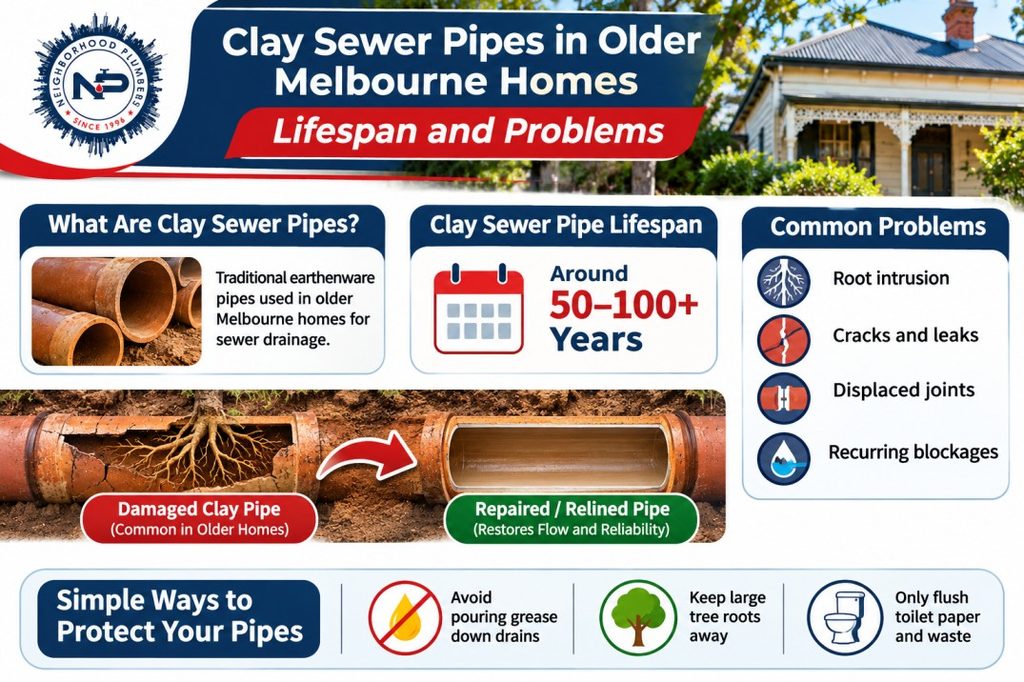
A cracked sewer pipe can affect drainage in several ways.
First, the damaged section may allow soil, sand or small debris to enter the pipe. These materials can collect inside the sewer line and obstruct normal wastewater movement.
Second, cracks can create uneven internal surfaces where waste becomes trapped.
Third, escaping wastewater may affect the surrounding ground, potentially contributing to further movement or damage.
A particularly important warning sign is a blockage that returns shortly after cleaning.
Instead of repeatedly treating the symptoms, a plumber should investigate whether the pipe has structural damage.
Older clay systems are made from connected pipe sections. Their joints can deteriorate or shift as the surrounding ground changes.
When a joint becomes displaced, the internal passage may no longer provide a smooth route for wastewater.
This can create a point where toilet paper, grease and other materials accumulate.
A CCTV drain inspection can help identify whether the problem is caused by a displaced connection, root intrusion or another structural fault.
Recognising early drainage symptoms can help homeowners arrange an inspection before a minor issue develops into a major plumbing problem.
If you are experiencing Blocked drains Broadmeadows, pay attention to the following warning signs.
When wastewater takes longer than usual to leave a sink, shower or bath, there may be a restriction somewhere in the drainage system.
A single slow fixture may indicate a localised blockage. However, multiple slow fixtures can suggest a problem further along the shared drainage line.
Gurgling noises often occur when air moves through a drainage system affected by restricted flow.
For example, flushing a toilet might produce bubbling sounds in a nearby shower drain.
This does not automatically confirm a damaged sewer pipe, but it is worth investigating if the noise occurs repeatedly.
Persistent sewage odours around external drains or inside bathrooms may indicate a drainage fault.
Possible causes include:
Persistent sewage smells should not be ignored, particularly when combined with slow drainage or overflowing fixtures.
An external inspection opening or gully that repeatedly overflows may indicate a restriction in the property’s sewer drainage system.
If wastewater is backing up, stop using affected fixtures where possible and arrange an appropriate plumbing assessment.
Avoid attempting to open or handle a sewage-filled inspection point yourself.
Effective drain cleaning involves identifying what is restricting the pipe and selecting a suitable method to remove it.
Simply forcing water through a blockage does not always resolve the underlying problem.
A CCTV inspection uses a specialised camera to examine the internal condition of underground drainage pipes.
The camera provides visual information about:
This inspection is particularly useful when a property experiences repeated blockages.
Rather than guessing where the problem is located, the plumber can examine the relevant section of the drainage system.
A useful inspection report should explain the fault’s location, its apparent severity and the recommended next steps.
High-pressure water jetting is commonly used to remove suitable obstructions from drainage pipes.
Depending on the condition of the system, it can help clear:
However, water jetting should be selected according to the pipe’s condition.
If a CCTV inspection identifies severely damaged or unstable pipework, aggressive cleaning may be inappropriate. The plumber should assess the pipe before deciding on the cleaning method.
Mechanical equipment can help remove certain obstructions, including root growth and compacted debris.
The appropriate equipment depends on the blockage type, pipe diameter and structural condition.
Older clay pipes require particular care because a cleaning method suitable for modern pipework may not be appropriate for a damaged section of an ageing system.
Not every blocked drain requires pipe replacement.
Sometimes, a professional cleaning service is enough to restore normal drainage. However, structural damage requires a different approach.
Homeowners researching sewer repairs Melbourne should understand the difference between a temporary obstruction and a permanent pipe defect.
Cleaning may be appropriate when:
If the blockage returns frequently, further investigation is advisable.
Pipe relining may be considered when an existing sewer pipe has suitable structural conditions for rehabilitation.
The process generally involves installing a resin-saturated liner inside the existing pipe. Once cured, the liner forms a new internal surface.
Potential benefits include:
However, relining is not suitable for every damaged pipe.
Severely collapsed sections, major alignment problems and certain structural defects may require excavation and replacement.
Replacement may be recommended when a pipe has extensive structural failure.
Examples include:
A responsible recommendation should be based on inspection findings rather than assumptions about the age of the property.
Broadmeadows includes residential properties of different ages, layouts and construction styles.
Where a property has older underground drainage infrastructure, its maintenance history becomes an important consideration.
A home may have undergone bathroom renovations, landscaping or driveway improvements without its original sewer pipework being replaced.
This means the visible condition of the property does not necessarily reflect the condition of its underground drainage.
Tree planting, garden redesign and landscaping work can affect underground drainage systems.
Roots may grow towards existing sources of moisture, particularly around damaged pipe connections.
Before planting large trees near known sewer routes, homeowners should consider underground service locations and suitable planting distances.
Yes. Excavation, new concrete installations, driveway construction and major landscaping can affect buried pipework if its location is not properly identified.
Before significant property work begins, locating underground services and understanding the existing drainage layout can reduce the risk of accidental damage.
Preventive inspections can be particularly useful when:
There is no universal inspection interval suitable for every property. The frequency should depend on pipe condition, previous faults and the surrounding environment.
Although homeowners cannot prevent every underground drainage problem, sensible maintenance can reduce avoidable damage.
The following steps are useful for properties with older clay sewer systems.
Cooking oil and grease can cool and solidify inside drainage pipes.
Over time, these deposits collect food particles and other waste, restricting wastewater movement.
Wipe greasy cookware with paper towels before washing it, and dispose of cooking oil appropriately.
Before planting large trees, consider where the underground sewer pipes are located.
Tree roots do not normally break through an intact pipe simply because they are nearby. However, existing cracks and defective joints can provide entry points.
If mature trees are already growing near an older sewer line, periodic inspections may help identify root intrusion early.
Toilets are designed to handle human waste and toilet paper.
Avoid flushing:
These materials can become trapped around roots, damaged joints and existing restrictions.
A drain that repeatedly blocks should not be treated as an ordinary maintenance issue indefinitely.
If cleaning restores drainage temporarily but the same problem returns, ask for an investigation of the underground pipework.
Retaining CCTV footage, inspection reports and repair documentation can help homeowners understand the condition of their drainage system.
These records are also useful when selling a property or arranging further maintenance.
Some drainage problems become more expensive because the underlying cause is overlooked.
Understanding common mistakes can help property owners make better maintenance decisions.
A blocked sink might be caused by accumulated grease, but recurring external sewer blockages may indicate deeper structural damage.
The correct approach is to identify the location and cause before choosing a treatment.
Chemical drain cleaners are not a permanent solution for damaged underground sewer pipes.
Some products may also be unsuitable for particular plumbing materials and fittings.
For repeated or serious blockages, professional diagnosis is generally more useful than repeatedly applying chemical treatments.
Age alone does not mean that a sewer pipe needs replacement.
A well-preserved clay pipe may continue functioning effectively for many years.
A CCTV inspection can help determine whether cleaning, targeted repairs, relining or replacement is appropriate.
Occasional slow drainage may appear insignificant, but recurring symptoms can indicate a developing problem.
Delaying an investigation can allow root intrusion, pipe displacement or leakage to become more extensive.
When assessing an older drainage system, it is important to look beyond the immediate blockage.
A useful inspection should establish three things.
First, identify the exact problem. Determine whether the restriction is caused by roots, grease, debris, a displaced joint or a damaged pipe.
Second, understand the condition of the surrounding pipework. A blockage may be located in one section, but the rest of the sewer line should also be considered when recurring faults are present.
Third, select a repair that addresses the actual defect. Cleaning is suitable for removable obstructions, while structural defects may require relining or replacement.
For example, consider a homeowner who experiences an overflowing external drain every few months. The drain is cleared, wastewater flows normally and the issue appears resolved. However, the same problem returns.
A CCTV inspection might reveal roots entering through an older clay pipe joint. In this situation, repeatedly clearing the blockage addresses the symptom rather than the cause.
The appropriate long-term solution depends on the extent of root growth and the structural condition of the pipe.
This diagnostic approach is important when dealing with Blocked drains Broadmeadows, particularly in properties where original underground drainage systems may still be in use.
Homeowners looking for experienced Plumbers in Broadmeadows should prioritise clear explanations, suitable inspection methods and repair recommendations supported by evidence.
For residents requiring assistance with recurring drainage problems, Neighborhood Plumbers can be considered when comparing local plumbing support. The important thing is to understand the condition of the existing system before committing to major work.
Some drainage symptoms require prompt professional attention rather than continued DIY troubleshooting.
Consider contacting a qualified sewer plumber when:
If sewage is overflowing, minimise contact with the wastewater, keep children and pets away and stop using affected fixtures where possible.
A qualified plumber can assess the situation and explain whether cleaning, repairs or further investigation is needed.
Clay sewer pipes have played an important role in older residential drainage systems, and many can continue functioning for decades when their material and connections remain in good condition.
However, their age, rigid construction and joint design can make them vulnerable to ground movement, root intrusion and cracking.
Understanding the clay sewer pipe lifespan helps homeowners recognise why regular drainage problems should not always be treated as simple blockages.
The best approach is to identify the actual cause, assess the condition of the underground pipework and choose a repair method based on inspection findings.
Whether you need routine cleaning or more extensive sewer repairs Melbourne, informed decisions can help prevent unnecessary excavation and repeated maintenance expenses.
If your property is experiencing recurring drainage issues, Neighborhood Plumbers can be considered for local plumbing assistance. Taking action when early warning signs appear can help protect your drainage system and reduce the risk of unexpected sewer problems.
The lifespan of clay sewer pipes depends on their material quality, installation, ground conditions and maintenance.
Vitrified clay pipe material can have a service life exceeding 100 years under suitable conditions. Some industry documentation uses a 150-year reference service life.
However, older residential systems may develop problems earlier because joints can deteriorate, soil can shift and roots can enter through openings.
A CCTV inspection is the most practical way to assess the current condition of an existing sewer line.
Early warning signs include recurring drain blockages, slow wastewater movement, gurgling sounds and persistent sewage odours.
Homeowners may also notice unexplained wet patches near underground drainage routes.
None of these symptoms independently confirms a cracked pipe. However, repeated problems involving several fixtures may indicate an issue within the main sewer line.
A professional inspection can help identify the cause.
Yes. Tree roots can gradually grow through defective joints and cracks, creating a dense obstruction inside the pipe.
Initially, wastewater may continue flowing around the roots. As the growth increases, it can collect toilet paper, grease and other debris.
Eventually, the available passage may become severely restricted.
Mechanical root removal or suitable water jetting may restore flow, but structural damage should also be assessed to determine whether further repairs are needed.
Neither option is automatically better. The correct solution depends on the pipe’s structural condition.
Relining may be suitable for certain cracked or leaking sections that retain an appropriate shape and alignment.
Replacement may be necessary where the pipe has collapsed, become severely displaced or suffered extensive damage.
A CCTV inspection helps determine which option is technically appropriate. Homeowners should compare the scope, expected service life, warranty and total cost of the proposed work.
Start by avoiding grease, wet wipes and unsuitable waste in your drainage system.
Keep large tree roots and landscaping changes in mind when planning work around underground sewer routes.
If your property has a history of recurring blockages, consider arranging a CCTV inspection to check the pipe’s internal condition.
For Blocked drains Broadmeadows, early diagnosis can help distinguish between ordinary obstructions and more serious underground pipe defects.