We are currently open! 12:34:21PM
Our Services



✖


Your home’s plumbing pipes work every day, carrying clean water to your kitchen, bathroom, laundry, and outdoor taps. Most of the time, you hardly think about them. However, small problems such as dripping joints, slow drains, changing water pressure, and hidden moisture can develop long before a pipe starts leaking badly.
The good news is that you do not always need expensive replacements to keep your plumbing system in good condition. Regular checks, sensible water use, timely repairs, and professional inspections can help identify problems early and reduce avoidable plumbing costs.
Following a practical Pipe Maintenance Guide is particularly useful for Melbourne homeowners because plumbing systems can face a range of challenges, including ageing pipework, tree root intrusion, mineral deposits, soil movement, and seasonal changes in water use. The exact risks depend on your property’s age, pipe material, installation quality, and local conditions.
Whether you live in an older home with original pipework or a newer property with modern plumbing, understanding how your system works can help you make better maintenance decisions.
This guide explains how Pipe Maintenance Melbourne homeowners can use simple preventative steps to extend pipe lifespan, recognise early warning signs, and know when professional help is needed. It also explains when Pipe Repairs Melbourne services may be necessary, which maintenance mistakes to avoid, and how to protect your home’s plumbing without spending money unnecessarily.
Plumbing pipes are designed to last for years, but their condition can deteriorate over time. Corrosion, excessive pressure, poor installation, unsuitable drain cleaning products, and physical damage can all shorten their useful life.
A small leak behind a vanity cabinet, for example, may initially appear harmless. If left unnoticed, it can damage the cabinet, weaken surrounding materials, encourage mould growth, and increase water consumption. Repairing the pipe early may be much simpler than addressing the damage caused by the leak.
Regular maintenance helps homeowners:
The goal is not to repair pipes that are still working properly. It is to identify genuine risks early and address them at the right time.
Before developing a maintenance routine, it helps to understand which pipes are installed in your property. Different materials have different strengths, weaknesses, and maintenance requirements.
Copper is commonly used in water supply systems because of its durability and resistance to many forms of damage. However, copper pipes can still develop pinhole leaks, corrosion, or joint failures under certain conditions.
Green or blue staining around exposed copper pipework can indicate corrosion, although the cause needs to be assessed rather than assumed.
Plastic pipes are widely used in drainage and some water supply applications, depending on the pipe type and its suitability for the installation. They resist many forms of corrosion, but can crack through impact, deteriorate under unsuitable exposure conditions, or fail at poorly installed connections.
Never assume that every plastic pipe is suitable for hot water or potable water. The pipe’s markings and intended application matter.
Older properties may contain galvanised steel water pipes. Over time, internal corrosion and mineral deposits can restrict the passage of water.
If several taps gradually lose pressure, an ageing or restricted supply pipe may be one possible cause. A plumber can determine whether cleaning, targeted repair, or replacement is the most appropriate option.
Pipe age alone does not determine whether replacement is necessary. A plumber should consider the material, visible condition, leak history, water quality, installation, and accessibility before recommending major work.
This assessment helps homeowners avoid both premature replacement and the risks of ignoring deteriorating pipework.
Preventative pipe maintenance means identifying and reducing plumbing risks before they turn into leaks, blockages, or major failures. It does not require specialist equipment for every task. A consistent routine can help you notice changes that would otherwise go unnoticed.
Start with the pipes you can safely see beneath kitchen sinks, bathroom vanities, laundry tubs, and outdoor taps.
Look for:
A dry tissue can help reveal a small leak around an accessible joint. Wipe the area dry, place the tissue underneath, and check whether moisture returns during normal use.
Practical example: A homeowner notices a small damp patch beneath the kitchen sink but assumes it came from washing dishes. Checking the cupboard after the sink has been unused for a while may help establish whether a supply connection is leaking. If moisture keeps returning, arrange an inspection rather than repeatedly drying the area.
Do not tighten unfamiliar fittings aggressively. Excessive force can damage threads, seals, or older connections.
Water pressure affects everyday tasks such as showering, washing dishes, and filling a washing machine. A sudden or gradual change can sometimes indicate a plumbing problem.
If several taps become weaker, possible causes include:
If only one tap has low flow, the cause may be much simpler, such as a blocked aerator or showerhead.
Notice whether the change occurs at one fixture or throughout the house. Check whether it started suddenly, developed gradually, or coincided with work on the water supply.
Avoid assuming that higher pressure is always better. Excessive pressure can place unnecessary strain on pipework, flexible hoses, valves, and appliance connections. A licensed plumber can measure pressure and assess whether it falls within the appropriate limits for your installation.
If pressure drops suddenly alongside visible water, unexplained dampness, or a suspected burst pipe, treat the situation as urgent.
Drainage pipes need attention too. Kitchen sinks collect grease and food residue, bathroom drains collect hair and soap deposits, and outdoor drains may receive leaves and garden debris.
A few habits can reduce blockages:
For minor, accessible clogs, a suitable plunger or careful cleaning of a removable strainer may be enough.
However, repeated blockages can indicate a deeper issue, such as pipe damage, incorrect drainage gradients, or tree root intrusion. Strong chemical drain cleaners can also damage certain plumbing materials or create hazards when mixed with other products.
If the same drain repeatedly backs up, investigate the underlying cause instead of treating the symptom every few weeks.
Pipes can be damaged during ordinary home improvement work. Drilling into a wall, installing shelves, replacing cabinetry, or digging in a garden can puncture concealed water lines.
Before drilling or cutting into walls and floors, determine where plumbing services may run. Use appropriate service-location information and professional assistance where necessary.
In gardens, avoid planting large trees directly above or close to underground drainage lines without considering the mature root system and pipe condition. Roots commonly exploit existing cracks or leaking joints; they do not necessarily break into every sound pipe.
If you are renovating an older property, consider a plumbing inspection before closing walls or covering accessible pipework. Discovering a problem during the renovation is generally easier than opening a finished wall later.
Flexible hoses under sinks, behind toilets, and near appliances can deteriorate with age and exposure. A failed hose can release substantial amounts of water in a short period, particularly when the supply remains pressurised.
Check accessible hoses for bulging, kinks, corrosion at metal fittings, cracking, or signs of moisture. Keep them free from tension and avoid storing heavy items against them.
There is no single replacement interval that applies to every hose. Follow the manufacturer’s recommendations and have older or questionable connections assessed by a plumber. Replacing a worn hose before it fails may be a sensible precaution, especially in a property that is unattended for extended periods.
Extending pipe lifespan requires more than fixing visible leaks. The aim is to reduce the conditions that accelerate deterioration and to identify problems before damage spreads.
Internal deposits can gradually reduce the effective diameter of some pipes. Corrosion may weaken metal pipework, while unsuitable water chemistry or dissimilar metal connections can contribute to deterioration in particular installations.
Warning signs include rusty-looking water, recurring discolouration, reduced flow, and repeated pinhole leaks. These symptoms can have other causes, so testing and inspection may be necessary.
Avoid using household chemicals to treat suspected pipe corrosion. If several fixtures show similar symptoms, ask a licensed plumber to assess the water supply and pipe material.
Melbourne homes vary considerably in age, construction, soil conditions, and plumbing design. A property in an established suburb may have ageing metal pipes or older drainage lines, while a newer home may have modern plastic pipework.
Ground movement, nearby trees, construction work, and changes in soil moisture can affect some underground pipes, especially where joints or existing defects are present.
This does not mean every Melbourne home has a ground-movement problem. It means maintenance decisions should be based on the property’s actual condition rather than a general assumption about the region.
Repeatedly forcing stiff taps, over-tightening valves, or using fixtures as supports can damage connections. Check for dripping taps and running toilets, as these can waste water and may indicate worn washers, cartridges, seals, or other components.
Fixing a faulty tap does not always require replacing the pipe behind it. The key is to identify which component has failed and repair that component appropriately.
Not every leak produces a visible puddle. Some develop inside walls, beneath flooring, or in underground supply lines.
Effective Leak Detection begins with noticing changes in the property and checking whether they can be explained.
One useful preliminary check is to observe the water meter when all taps and water-using appliances are off. If the meter continues to register water use, there may be a leak or another source of consumption.
For a more meaningful test, make sure toilets are not refilling, automatic appliances are not operating, and any other water use has stopped. Follow the water provider’s guidance for reading your meter.
A moving meter does not prove that a pipe is leaking. A running toilet, irrigation system, or other connected fixture may be responsible.
A plumber may use acoustic equipment, thermal imaging, pressure testing, or other suitable diagnostic methods depending on the suspected leak and the building materials.
These methods are not interchangeable. Thermal imaging, for example, identifies temperature differences rather than directly confirming every leak. A professional combines test results with the location, pipe layout, and visible evidence.
Avoid cutting into walls or lifting flooring based only on a damp patch. A targeted investigation can help limit unnecessary damage.
A planned Plumbing Inspection helps assess the condition of visible pipework, accessible valves, water connections, drainage symptoms, and other relevant components.
The right inspection frequency depends on the property’s age, plumbing material, previous leaks, and risk factors. There is no universal rule requiring every home to undergo the same inspection every year.
An inspection is particularly worth considering when:
An inspection should lead to useful findings, not an automatic recommendation to replace everything. Ask the plumber to distinguish between immediate defects, items that need monitoring, and optional upgrades.
For Pipe Maintenance Melbourne homeowners, this approach helps prioritise safety and genuine plumbing risks while keeping maintenance decisions proportionate to the evidence.
Routine maintenance can prevent some problems, but it cannot reverse serious corrosion, repair a cracked pipe, or restore every damaged connection.
Professional Pipe Repairs Melbourne services may be necessary when a pipe leaks repeatedly, a joint fails, a drainage line becomes damaged, or water supply problems persist despite basic checks.
| Warning sign | Possible cause | Recommended action |
|---|---|---|
| Water spraying from a pipe | Burst pipe or failed connection | Isolate the water supply if safe and seek urgent plumbing assistance |
| Repeated pinhole leaks | Corrosion or pipe deterioration | Arrange an assessment of the affected pipework |
| Several drains backing up | Main drain blockage or damaged line | Avoid continued use and arrange a drainage inspection |
| Persistent dampness in walls | Concealed leak or another moisture source | Investigate before opening the wall |
| Rust-coloured water | Corrosion, sediment, or a supply issue | Determine the source before choosing a repair |
| Sudden loss of water pressure | Supply issue, leak, or restricted pipe | Check whether the issue affects one fixture or the whole property |
If water is near electrical equipment, do not touch wet electrical components. Keep people away from the affected area and contact the appropriate emergency professionals.
A localised repair may be suitable if a single fitting or accessible pipe section has failed while the surrounding pipework remains sound.
Replacement may be more practical when the system has widespread corrosion, repeated failures in different locations, severely restricted internal flow, or pipe materials that are unsuitable for the installation.
Consider these factors before approving major work:
For example, repairing one damaged joint in an otherwise sound system may be reasonable. If several ageing pipes have developed leaks within a short period, repeated patch repairs may cost more over time than a planned replacement.
Ask for a clear explanation of the defect, the available options, and the likely consequences of delaying the work.
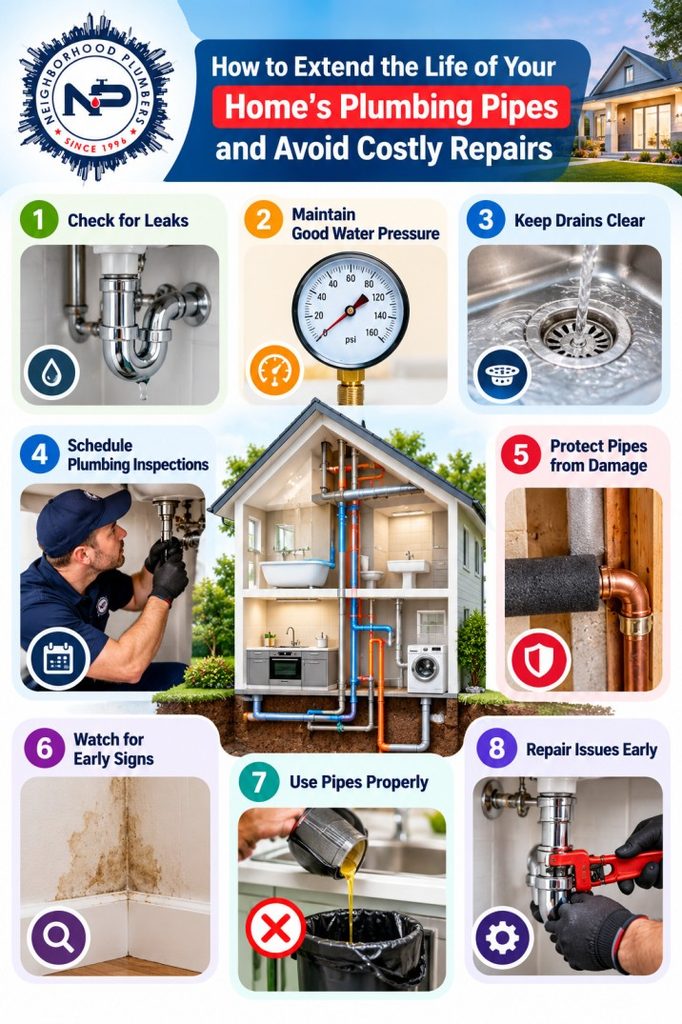
A manageable routine is more useful than an ambitious checklist that is quickly forgotten. Use the following schedule as a starting point, adjusting it to your property’s condition and the manufacturer’s maintenance recommendations.
Inspect accessible pipes beneath sinks, look for unexplained moisture, check for dripping taps, and notice any changes in water pressure or drainage.
Clean accessible strainers, remove outdoor debris, check visible appliance hoses, and investigate unexplained changes in water consumption.
Consider a professional assessment if the home is older, has a history of leaks, or shows signs of deterioration. The appropriate interval depends on risk and condition.
Check for visible leaks, ensure appliances and taps are not left running unnecessarily, and identify the main water isolation valve so you know where it is if an emergency occurs.
This schedule is a practical guide rather than a substitute for maintenance instructions specific to your plumbing system.
Even well-intentioned homeowners can accidentally make plumbing problems worse.
A slow drip may seem insignificant, but it can damage cabinetry, flooring, and wall materials. Investigate recurring moisture instead of assuming it will stop on its own.
Chemical cleaners may be unsuitable for particular pipes and can create dangerous reactions when mixed. Mechanical cleaning or professional diagnosis may be safer, especially for recurring blockages.
A blocked tap aerator, faulty pressure regulator, partially closed valve, or external supply problem can cause similar symptoms. Check the pattern before deciding on a repair.
Replacing a washer or cleaning a removable strainer may be manageable for some homeowners. Working on concealed supply pipes, pressurised systems, or complex drainage problems can create further damage if done incorrectly.
In Victoria, plumbing work must comply with applicable licensing and regulatory requirements. Use a suitably licensed plumber for work that requires professional plumbing expertise.
Older pipes deserve attention, but age alone does not prove that a system has failed. A condition assessment helps determine whether monitoring, a localised repair, or planned replacement is justified.
Good residential plumbing care is about understanding the warning signs, maintaining accessible components, and acting before a minor defect becomes a major problem.
The following practical habits can make a real difference.
Know where your main water shut-off valve is. In a leak emergency, knowing how to isolate the supply can reduce the amount of water released. Make sure the valve is accessible and ask a plumber for help if it is difficult to operate.
Keep records of plumbing repairs. Note the date, location, material, and nature of each repair. If the same section develops problems repeatedly, these records help the plumber identify a pattern.
Investigate recurring problems rather than repeatedly treating symptoms. A drain that blocks every month or a joint that leaks after repeated repairs may have an underlying defect that needs a different solution.
Check the source of unexplained water bills. Compare usage over similar periods and account for household occupancy, irrigation, and appliance use. If consumption remains unusually high, inspect toilets and visible connections before arranging further investigation.
Ask for evidence before approving expensive work. Request an explanation of the defect, photographs where useful, the reason for the proposed repair, and a breakdown of the available options. Where replacement is recommended, ask whether the problem is isolated or widespread.
At Neighborhood Plumbers, the most useful maintenance advice is practical and proportionate: identify the problem, understand its likely cause, and choose a repair that suits the condition of the plumbing rather than replacing components unnecessarily.
Keeping your home’s plumbing in good condition does not have to be complicated. Regularly check accessible pipes, pay attention to water pressure, protect drainage systems from unsuitable waste, and investigate dampness or unexplained water consumption before the problem becomes more serious.
A consistent Pipe Maintenance Guide can help homeowners make informed decisions about preventative maintenance, extending pipe lifespan, and scheduling repairs when they are genuinely needed. Remember that early warning signs are useful clues, not definitive diagnoses. Professional assessment is important when the cause is unclear, or the damage may be concealed.
For homeowners considering Pipe Maintenance Melbourne solutions, the best approach is to focus on the actual condition of the plumbing, rather than relying on pipe age alone. Timely Pipe Repairs Melbourne services can address confirmed defects, while a sensible maintenance routine can help reduce avoidable disruption.
Neighborhood Plumbers can be mentioned as a local option for homeowners who need professional guidance on plumbing concerns. The priority should always be a clear diagnosis, an explanation of suitable options, and work that addresses the underlying problem. With regular checks and timely action, you can protect your home, manage maintenance costs, and keep your plumbing system working reliably for years to come.
The frequency depends on the age, material, and condition of your plumbing. A home with newer pipework and no history of leaks may need only routine visual checks and inspections when concerns arise. An older property with corrosion, repeated leaks, or changing water pressure may benefit from more frequent professional assessments. Monthly visual checks are a useful starting point, but they do not replace a targeted inspection when warning signs appear.
Common warning signs include damp cupboards, unexplained water bills, recurring blockages, rusty-looking water, reduced flow, and water stains on walls or ceilings. You may also hear running water when all fixtures are off. None of these signs proves that a pipe has failed, but they justify further investigation if the problem persists. If a pipe bursts or water is spreading rapidly, isolate the supply if safe and seek urgent assistance.
Yes, it can reduce some avoidable costs by helping identify leaks, deteriorating hoses, and drainage problems before they cause extensive damage. For example, repairing a leaking connection early may prevent damage to a kitchen cabinet or nearby flooring. However, maintenance cannot prevent every failure, particularly where pipes have severe corrosion or hidden structural damage. Its main benefit is earlier detection, better planning, and fewer surprises.
Pipe maintenance involves routine checks, monitoring water pressure, keeping drains clear, inspecting accessible connections, and identifying early warning signs. Pipe repairs involve correcting an existing defect, such as a leaking joint, cracked pipe, or damaged drainage section. Maintenance may help reduce the likelihood of some failures, but repairs become necessary when a defect is identified. Repeated problems should be investigated to determine whether a larger section of pipework needs attention.
The decision should be based on the pipe material, condition, leak history, corrosion, water flow, and likely future reliability. A single damaged fitting may need only a localised repair. Widespread corrosion, repeated leaks, or severely restricted pipework may justify replacement. Ask a licensed plumber to explain the evidence, compare repair and replacement options, and identify any risks associated with delaying the work. This helps you avoid both unnecessary replacement and repeated spending on an unreliable system.