We are currently open! 12:34:21PM
Our Services



✖


A hot shower on a cold Melbourne morning is something most homeowners take for granted—until the water suddenly turns cold, the hot water takes too long to reach the tap, or an unexpected leak appears around the storage tank. These problems can be frustrating, especially when they happen during a busy morning or when guests are staying over.
Regular Hot Water System Maintenance Melbourne homeowners can arrange or perform safely can help identify early warning signs, improve day-to-day reliability, and reduce the risk of avoidable breakdowns. However, maintenance is not simply about checking whether hot water comes out of the tap. The type of system you own, its age, installation conditions, water quality, and the manufacturer’s recommendations all affect what needs attention.
This practical Hot Water Maintenance Guide explains how to inspect your system visually, recognise common warning signs, understand the difference between routine checks and professional servicing, and decide when a licensed plumber or qualified technician should investigate a problem.
Whether your home uses a traditional storage tank, a continuous-flow gas unit, or a heat pump water heater, a sensible annual maintenance routine can help you make informed decisions about your equipment without attempting unsafe repairs.
Hot water systems work repeatedly throughout the year. They heat water, manage pressure and temperature, and operate alongside plumbing connections, valves, and other components. Over time, individual parts can wear out, connections can deteriorate, and certain systems may accumulate sediment or develop scale.
The amount of maintenance required depends on the equipment. A storage water heater does not have exactly the same needs as a continuous-flow unit or a heat pump system.
Good Hot Water Maintenance helps homeowners identify developing problems before they become disruptive. It can also provide useful information when deciding whether an ageing unit needs a repair, more frequent servicing, or eventual replacement.
Several issues can develop when warning signs go unnoticed:
Maintenance cannot guarantee that a system will never fail. Its purpose is to identify risks, keep serviceable components in suitable condition, and address faults before they cause greater inconvenience.
Before following an annual checklist, identify the type of Water Heater installed at your property. This matters because different systems have different components, servicing requirements, and safety considerations.
These units store heated water in an insulated tank. Depending on the model, maintenance considerations may include the pressure-relief components, electrical heating elements, thermostat, tank condition, and any sacrificial anode fitted to protect against corrosion.
These systems heat water as it passes through the unit. A qualified technician may need to assess the burner, combustion and ventilation arrangements, heat exchanger, ignition system, and water connections.
Heat pumps use electricity to move heat from the surrounding air into water. Their maintenance needs can include checking airflow, inspecting accessible components, keeping the surrounding area clear, and arranging professional checks of the refrigeration and electrical systems where required.
If you are unsure which model you have, check the manufacturer’s label and user manual. Record the brand, model number, installation date if known, and any previous service history. This information helps a technician identify the correct maintenance procedure.
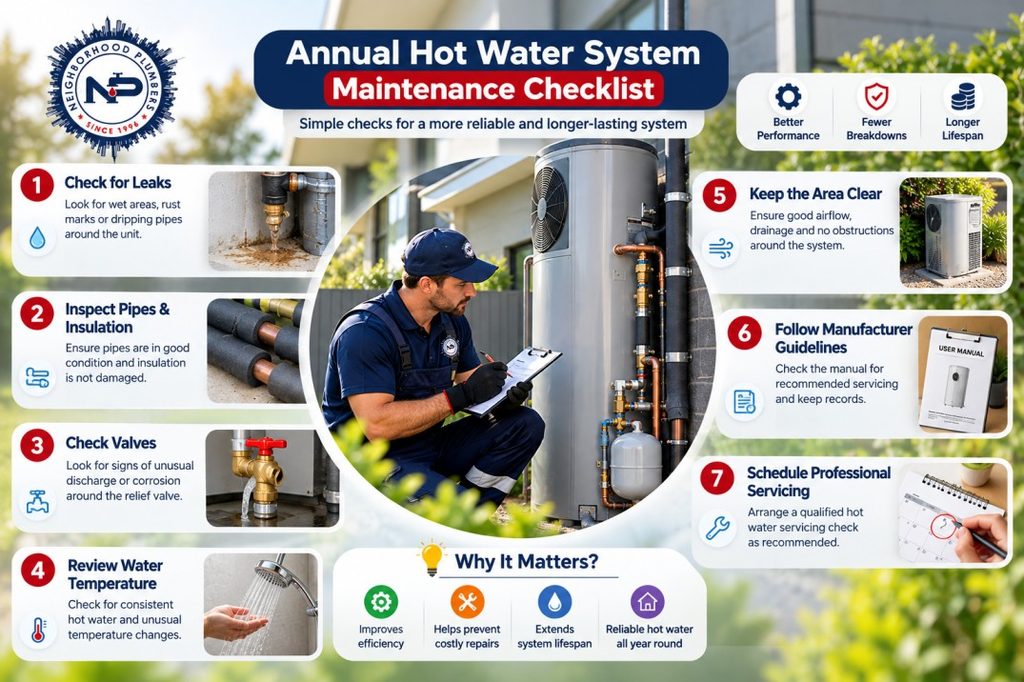
A planned annual check is easier to manage when you know what to look for and which tasks should be left to a professional. The following checklist focuses on visible warning signs and sensible maintenance habits rather than risky DIY repairs.
Start with a visual inspection of the accessible areas around your hot water unit. Look for:
A small amount of water does not always mean the tank has failed. Some systems may discharge water through designated drainage arrangements during normal operation. However, continuous dripping, unexplained pooling, or increasing moisture should not be ignored.
Practical example: Imagine a homeowner notices a small wet patch beside the tank every morning. It disappears later in the day, so it seems harmless. Rather than assuming the water is condensation, the homeowner records when it occurs and arranges an assessment. A technician can then determine whether the source is a connection, valve, condensation, or a more serious fault.
Do not dismantle the unit or tighten pressurised fittings yourself. If a leak is active or spreading, seek prompt professional advice.
Pipework carries heated water from the system to your taps and showers. Damaged insulation can allow heat to escape, while deteriorating connections may contribute to leaks.
During your visual check, look for:
Insulation should be appropriate for the pipe and installed in a way that complies with relevant requirements. Avoid covering components that need ventilation, access, or drainage.
If you notice a damaged section, have a qualified professional determine whether it needs repair or replacement. This is especially important where pipes are concealed, hot, pressurised, or close to electrical equipment.
Many storage systems include temperature and pressure relief components designed to help protect the equipment from unsafe operating conditions. Some systems also have expansion-control valves.
A discharge pipe may release water under certain operating conditions, so the mere presence of water is not enough to diagnose a fault. What matters is the system design, the location and frequency of discharge, and whether the behaviour matches the manufacturer’s guidance.
Look for visible signs such as:
Do not cap a discharge pipe, obstruct an outlet, or attempt to disable a safety device. Never test or operate a relief valve unless the manufacturer specifically provides a safe procedure for the user. Hot discharge can cause serious burns.
If you suspect a valve problem, arrange an assessment by a suitably qualified plumber. Victorian guidance highlights the importance of correctly installed and safely drained temperature-pressure relief valves.
Pay attention to changes in how your system performs. Does the shower become cold sooner than usual? Does hot water take longer to arrive? Are temperatures inconsistent between uses?
These symptoms can have several causes, including increased household demand, a change in system settings, a faulty component, a plumbing issue, or a developing equipment fault.
Record what you observe before arranging a service visit. Useful details include:
Do not increase the thermostat setting simply because the water feels cooler. Storage systems require appropriate temperature control for both scald prevention and hygiene. Any adjustment should follow the manufacturer’s instructions and applicable Victorian requirements, with professional assistance where needed.
The area around the hot water unit matters as much as the visible equipment. Poor drainage, clutter, or restricted airflow can create maintenance problems.
For your annual System Inspection, check that:
For heat pump systems, keep the required airflow clear around the unit. For gas appliances, do not block ventilation openings or alter flues.
Never climb onto a roof, access a confined space, or remove appliance covers to complete a routine homeowner inspection. These tasks may introduce fall, electrical, gas, or scalding hazards.
One of the most useful steps is to read the maintenance section of the product manual. It should help you identify the servicing requirements for your particular model.
Depending on the system, professional checks may involve components such as:
Not every unit contains every component, and service intervals differ between models. A universal annual checklist should not replace a manufacturer’s specified maintenance schedule.
Keep service records, invoices, model details, and any warranty documents together. These records can help identify recurring faults and make future maintenance decisions more straightforward.
Visual checks can help you spot warning signs, but they cannot confirm that the internal components are operating correctly. Professional Hot Water Servicing should be appropriate to the type, age, condition, and manufacturer requirements of the unit.
Depending on the system and the reported symptoms, a qualified technician may:
The scope of a service varies. A routine inspection does not automatically include replacing parts, flushing a tank, cleaning internal components, or carrying out repairs.
Ask what is included before the appointment, particularly if the system has a history of faults. A clear explanation of the findings helps you understand which work is necessary now and which items can be monitored.
The aim of preventative hot water maintenance is to identify developing problems and follow the correct service procedures before a fault causes unnecessary disruption.
Some storage systems can accumulate sediment, while mineral deposits can affect certain components in areas with harder water. The extent of the problem depends on water quality, system design, operating conditions, and the equipment’s maintenance history.
Possible symptoms include unusual operating noises, inconsistent performance, or reduced heating efficiency. These symptoms do not prove sediment is the cause, so they should be assessed rather than treated with an unverified DIY cleaning method.
A professional can determine whether cleaning, flushing, descaling, or another procedure is suitable for the specific model.
Parts such as seals, valves, heating elements, controls, and anodes may deteriorate over time. Early assessment can help establish whether a component needs attention before the entire system becomes unreliable.
For example, a storage tank with an ageing sacrificial anode may require a model-specific inspection to determine the anode’s condition. Replacing it when recommended may help protect the tank against corrosion, but it cannot reverse damage that has already occurred.
Incorrect settings, restricted airflow, poor drainage, or unresolved plumbing faults may affect some systems. Regularly reviewing the unit’s condition and following the manufacturer’s instructions helps keep it operating as intended.
There is no single maintenance action that guarantees a longer service life. The greatest benefit comes from matching the maintenance routine to the actual equipment and responding promptly when warning signs appear.
A manageable schedule makes Plumbing Maintenance easier to remember without encouraging unnecessary inspections or repairs.
| Frequency | Homeowner action | When to seek professional help |
|---|---|---|
| Monthly or during routine household checks | Look for leaks, dampness, visible damage, or changes in performance | If a leak, corrosion, or unusual discharge is noticed |
| When performance changes | Record temperature changes, unusual sounds, or reduced hot water availability | If the problem persists or recurs |
| At the manufacturer’s recommended interval | Review service requirements and organise the appropriate inspection | When the manual specifies servicing or a component check |
| Annually as a planning reminder | Review the unit’s condition, maintenance records, and service history | If a service is due or the system has unresolved warning signs |
| After severe weather or nearby plumbing work, where relevant | Look for visible damage or new leaks without dismantling the unit | If the unit, pipework, or supports appear damaged |
This schedule is a practical reminder, not a universal technical servicing interval. The manufacturer’s instructions and the condition of the equipment should determine the actual maintenance requirements.
For homeowners managing several maintenance tasks, keeping the hot water system’s service date alongside other household records makes it easier to track recurring issues and arrange inspections in good time.
Neighborhood Plumbers provides reliable plumbing services in Melbourne, including emergency plumbing, leak detection, blocked drain clearing, and pipe repairs to help residential and commercial customers maintain safe and efficient plumbing systems.
Even well-intentioned homeowners can make maintenance more complicated by following advice that does not suit their equipment.
An electric storage tank, a gas continuous-flow heater, and a heat pump have different components and servicing requirements. Always use the correct manual and maintenance schedule rather than applying a generic procedure to every unit.
A small drip may seem unimportant, particularly if the hot water still works. However, recurring moisture can damage nearby surfaces and may indicate a deteriorating connection or component.
Investigate the source instead of repeatedly wiping the area dry and assuming the problem has disappeared.
Relief valves, temperature controls, and other safety components are not ordinary household fittings. Do not cap, bypass, dismantle, or adjust them to stop a discharge or change the water temperature.
A qualified professional should investigate suspected safety-device faults.
Removing appliance covers, working on electrical connections, altering gas components, or opening pressurised equipment can expose you to serious hazards.
Homeowners should stick to safe visual observations and manufacturer-approved user checks. Repairs and technical servicing should be completed by appropriately qualified professionals.
An ageing system does not always need immediate replacement, just as a relatively new system is not automatically free from faults.
Before deciding, ask the technician to explain the cause of the problem, the condition of the major components, the likely cost of repair, and whether further issues are reasonably foreseeable. Compare repair and replacement options using the actual condition of the equipment rather than age alone.
The most useful maintenance decisions are usually the ones that prevent uncertainty from building up over time.
These steps support extending system lifespan by helping homeowners identify issues early and make better-informed maintenance decisions. They do not eliminate normal wear or guarantee a specific number of additional years.
Knowing when to stop checking the system yourself is an important part of responsible maintenance.
Contact a suitably qualified professional if you notice:
If you smell gas, suspect a gas leak, or notice signs of combustion problems, move away from the affected area and follow the relevant emergency guidance. Do not operate electrical switches or use flames in an area where a gas leak is suspected.
If water is leaking near electrical equipment, do not touch wet components or enter a flooded area where electrical hazards may be present. If safe, keep clear and seek urgent assistance.
When selecting a provider, check that the professional has the appropriate licence or registration for the work being undertaken in Victoria. Ask for a clear explanation of the inspection findings, recommended work, and any limitations of the assessment.
A reliable hot water system depends on more than whether the water is hot today. Its condition, safety components, plumbing connections, operating settings, and maintenance history all influence how well it performs over time.
This Hot Water Maintenance Guide provides a practical starting point: inspect visible areas, record unusual symptoms, follow the manufacturer’s instructions, and arrange professional attention when warning signs appear. Avoid unsafe DIY repairs and do not assume that every system needs the same maintenance procedure.
For homeowners planning Hot Water System Maintenance Melbourne, the best approach is to use an annual review as a reminder to check the equipment’s condition and service history, while following the actual maintenance intervals specified for the model.
Consistent routine servicing, prompt investigation of faults, and sensible maintenance decisions can help reduce avoidable disruption and support a longer useful service life. If your system is showing signs of deterioration, a professional assessment can help you understand the next steps before the problem becomes more disruptive.
The recommended interval depends on the system’s make, model, age, operating conditions, and manufacturer’s instructions. An annual household review is a useful opportunity to check for visible problems and review the service history, but it does not mean every system requires a full professional service every year.
Check the user manual and ask a qualified technician to confirm the appropriate servicing schedule. Older systems, equipment with recurring faults, or units operating in demanding conditions may need more frequent attention.
Common warning signs include unexplained leaks, inconsistent water temperatures, reduced hot water availability, visible corrosion, unusual noises, and changes in how the system operates.
One symptom does not necessarily identify the cause. For example, reduced hot water may result from increased household demand, a heating fault, or a control issue. Record when the problem occurs and which fixtures are affected, then arrange an assessment if it persists, recurs, or presents a safety concern.
It can help in some circumstances. For example, addressing a fault, correcting an unsuitable operating condition, or maintaining components as recommended may improve the performance of certain systems.
However, maintenance does not guarantee lower bills. Energy consumption also depends on the system’s efficiency, household hot water usage, temperature settings, installation, and energy tariff. If your bills increase unexpectedly, compare usage patterns and ask a qualified technician to investigate any suspected equipment fault.
Start with observations that do not require removing covers or touching hot, electrical, gas, or pressurised components. Look for visible leaks, corrosion, damaged pipe insulation, changes in hot water supply, and unusual sounds.
Record the system’s make and model, its approximate age, the symptoms you have noticed, and any previous repairs. Do not operate safety valves or attempt to dismantle the unit unless the manufacturer explicitly provides an appropriate safe user procedure. Share your observations with the technician so they can plan the assessment.
Not always. Maintenance can help identify wear, address suitable faults, and support the reliable operation of serviceable equipment. It cannot reverse all deterioration or guarantee that a tank, heating component, or control system will never fail.
When a system develops recurring faults, leaks from the tank itself, or significant deterioration, ask for a professional assessment of its condition. Compare the likely repair costs, expected reliability, replacement options, and warranty considerations before making a decision.