We are currently open! 12:34:21PM
Our Services



✖


When a tap starts dripping, a pipe begins leaking, or a toilet refuses to flush, the first question many homeowners ask is whether they need a licensed plumber or a handyman. Both professionals can help with home maintenance, but their skills, responsibilities and legal authority are not the same.
Choosing the wrong person for a plumbing job can lead to recurring leaks, water damage, poor workmanship and unexpected repair costs. Some minor maintenance tasks are suitable for a capable handyman, while other jobs require specialist plumbing knowledge, appropriate licensing and compliance with Victorian regulations.
Understanding the difference between a Plumber vs Handyman can help you make a safer and more cost-effective decision. If you are comparing options for a Licensed Plumber Melbourne, it is important to consider the nature of the problem, the potential risks and the qualifications required for the work.
This guide explains which professional is suitable for different household plumbing tasks, when a licensed plumber is necessary, and how to avoid common mistakes when arranging plumbing repairs.
Plumbing systems involve interconnected pipes, drainage lines, water pressure, fixtures and, in some homes, gas appliances. A problem that appears minor on the surface may have a more complicated cause.
For example, a small damp patch beneath a kitchen sink might result from a loose connection. However, it could also indicate a cracked pipe, a failing waste connection or water escaping from a concealed fitting.
A handyman may be able to identify an obvious maintenance issue and complete certain minor tasks. However, diagnosing a hidden plumbing fault or altering a water supply system requires specific technical knowledge.
The distinction matters for three main reasons.
Safety: Incorrect repairs can cause leaks, contamination risks, flooding or damage to surrounding structures.
Legal compliance: Certain plumbing work in Victoria must be performed by an appropriately licensed or registered plumbing practitioner.
Long-term reliability: A repair should address the cause of a problem rather than temporarily conceal its symptoms.
The right choice depends on what needs to be done, not simply on which professional offers the lowest initial price.
A licensed plumber is a plumbing professional who holds the appropriate licence for the work they are legally authorised to perform. In Victoria, the Victorian Building Authority (VBA), operating within the state’s building and plumbing regulatory framework, oversees plumbing practitioner registration and licensing.
Plumbing qualifications and authorisations vary according to the type of work involved. For example, water supply plumbing, sanitary plumbing, drainage and gasfitting involve different technical requirements and may require specific endorsements.
A suitably qualified plumber can assess a plumbing problem, identify its likely cause, recommend an appropriate repair and carry out work within their authorised scope.
Depending on their qualifications and endorsements, plumbing practitioners may undertake work such as:
Not every plumber is authorised to perform every type of plumbing work. Homeowners should confirm that the practitioner holds the relevant registration or licence for the specific job.
Professional plumbing involves more than connecting pipes or tightening fittings. A plumber must understand pipe materials, flow rates, pressure, drainage gradients, backflow risks and the compatibility of different plumbing components.
Consider a home where the water pressure has suddenly dropped. Replacing a tap might not solve the issue if the underlying cause is a faulty pressure-control device, a partially closed isolation valve or a leak elsewhere in the system.
A qualified professional can investigate these possibilities systematically instead of relying on guesswork.
This is particularly important when a repair involves concealed pipework, changes to existing plumbing or connections to a larger water or drainage system.
A handyman generally handles minor repairs, installations and general property maintenance. Their services may include fixing cupboard doors, assembling furniture, patching small wall defects and carrying out certain simple fixture-related tasks.
However, a handyman does not automatically have the qualifications or legal authority to undertake regulated plumbing work.
The important distinction is between general maintenance and work that falls within Victoria’s regulated plumbing activities.
A handyman may be appropriate for tasks that do not require regulated plumbing work, provided they have the necessary practical skills.
Examples may include:
The precise boundary depends on the task. A job that appears to involve only a fixture may require disconnecting or altering water supply, drainage or other regulated plumbing components.
For this reason, homeowners should not assume that every tap, toilet or sink repair is suitable for a handyman.
A handyman should not undertake plumbing work that legally requires a licensed or registered practitioner unless they hold the appropriate authorisation themselves.
Examples of work that may require an appropriately authorised plumber include:
A handyman who also holds the relevant plumbing qualifications and authorisation may legally perform work within that scope. The professional’s actual credentials matter more than their job title.
The main difference is the type of work each professional is qualified and authorised to perform.
| Comparison | Licensed Plumber | Handyman |
|---|---|---|
| Main responsibility | Plumbing diagnosis, repair and installation within their authorised scope | General repairs and property maintenance |
| Plumbing qualifications | Holds relevant plumbing registration or licence | Qualifications vary; plumbing authority is not automatic |
| Pipe Repairs | Suitable for regulated pipe repairs within their scope | Limited to tasks that do not require unauthorised plumbing work |
| Water supply modifications | Requires appropriate plumbing authorisation | Should not undertake regulated work without the required authority |
| Drainage faults | Can investigate and repair within their scope | May assist with non-plumbing maintenance after the fault is resolved |
| General household repairs | May provide related services, depending on the business | Common area of work |
| Plumbing compliance | Can provide applicable documentation when authorised and required | Cannot replace required plumbing compliance documentation |
| Best use | Plumbing faults, regulated repairs and specialist diagnosis | Suitable minor maintenance and non-regulated repairs |
The distinction is not about one professional being more useful than the other. Both can play an important role in maintaining a property, provided the job matches their skills and legal authority.
Some plumbing problems are easy to notice but difficult to diagnose correctly. If a task involves water supply, drainage, concealed pipework or potentially significant water damage, a licensed plumbing professional is generally the safer choice.
Here are common situations where specialist plumbing assistance is appropriate.
A leaking pipe can cause damage to cabinetry, plasterboard, flooring and structural materials. Even a slow leak may worsen over time, especially if the pipe is concealed behind a wall or beneath a floor.
For example, a homeowner might notice a damp patch inside a kitchen cabinet. Drying the cabinet and applying sealant may make the area appear better temporarily, but neither action identifies the source of the moisture.
A plumber can inspect the accessible connections, test the system where appropriate and determine whether the issue involves a fitting, pipe or another component.
For regulated pipe repairs, choose a practitioner authorised to perform the required work.
A slow-draining sink may be caused by an accessible accumulation of hair, grease or food debris. However, recurring blockages can indicate a deeper issue.
Possible causes include:
If several fixtures drain slowly at the same time, or wastewater returns through a floor drain, the problem may involve the property’s larger drainage system.
A plumbing professional can investigate the cause and determine the appropriate repair instead of repeatedly treating the same symptoms.
A toilet that continuously runs, leaks around its base or struggles to flush may have a faulty internal component, a damaged seal or a problem with its water supply or drainage.
Some simple observations can help narrow down the issue. For example, a constantly refilling cistern may suggest a problem with its inlet valve or flushing mechanism.
However, water leaking around the toilet’s base requires careful investigation because it may involve the seal, waste connection or another fault.
A handyman may be able to address unrelated maintenance around the toilet, but plumbing repairs should be completed by a practitioner with the required authorisation.
A hot water system can develop leaks, inconsistent temperatures, unusual noises or problems with its controls.
The appropriate response depends on the system type and the source of the fault. Gas hot water systems introduce additional safety considerations, while electric systems may involve electrical hazards.
Do not attempt to dismantle gas components, bypass safety devices or work on electrical connections unless appropriately qualified and authorised.
A suitable plumbing professional can assess the issue and determine whether a plumbing, gasfitting or electrical specialist is required.
Low water pressure can affect showers, taps and appliances. The cause may be a partially closed valve, a faulty pressure-control component, a leak, a restriction or an issue with the wider water supply.
Replacing individual fittings without investigating the underlying problem may waste money.
A plumber can assess the affected fixtures, compare pressure at different points where appropriate and recommend a repair based on the findings.
Renovating a bathroom, kitchen or laundry may involve moving water outlets, changing drainage connections or installing new fixtures.
These tasks can require regulated plumbing work and must comply with applicable Victorian requirements.
Before work begins, confirm which practitioner will undertake the plumbing, whether permits or compliance certificates are required, and how the new installation will be tested.
A handyman can help with cabinetry, painting, shelving and other suitable finishing work, but regulated plumbing should be allocated to an appropriately authorised professional.
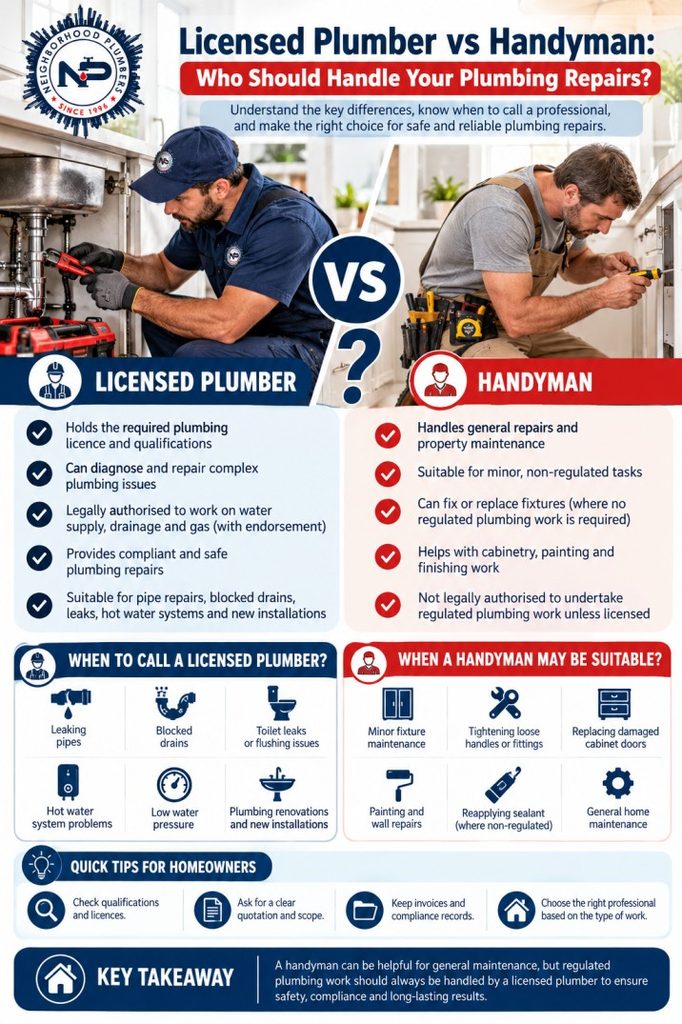
Not every maintenance issue requires a plumber to complete the entire job. The key is to separate the plumbing fault from the surrounding property repairs.
For instance, suppose a leaking pipe damages the base of a bathroom vanity.
A sensible sequence is to have an appropriately authorised plumber identify and repair the leak first. Once the area is dry and the plumbing issue has been resolved, a handyman or cabinet repair specialist may replace the damaged panel.
This approach avoids paying one professional to perform work outside their expertise.
Similarly, if a bathroom renovation involves replacing damaged skirting boards, repairing plaster or painting a wall, a handyman may be suitable for those tasks. The plumbing connections should be handled by the appropriate practitioner.
When in doubt, ask the handyman to clarify whether the proposed task involves disconnecting, modifying or repairing a plumbing system. If it does, verify the legal requirements before proceeding.
Homeowners should understand that plumbing work in Victoria is subject to specific regulatory requirements. The legal position depends on the type of work, the practitioner’s authorisation and the applicable exemptions.
Qualified plumbing work is work undertaken by someone with the necessary training, competence and authorisation for the particular task.
For regulated work, the relevant practitioner must hold the required registration or licence. Having general trade experience does not automatically satisfy these requirements.
Before hiring a professional, consider the following checks:
You can verify practitioner details through the Victorian Building Authority’s official practitioner register.
These checks are particularly important for work involving drainage, water supply alterations, gasfitting and major plumbing installations.
Legal plumbing requirements may include using an appropriately authorised practitioner, complying with applicable plumbing standards and obtaining the required documentation.
In Victoria, a plumbing compliance certificate is generally required for prescribed plumbing work where the total value of the work, including labour, materials and GST, is $750 or more. Certain categories, including some gasfitting and specified plumbing work, may require a certificate regardless of the value.
Because the rules can depend on the type of work and current regulations, confirm the requirements with the VBA or your plumbing practitioner before work begins.
A certificate should not be treated as a general guarantee that every aspect of a property is free from defects. It is a regulatory document associated with the relevant plumbing work.
Non-compliant plumbing can create problems when a fault develops, a property is sold or an insurer investigates water damage.
Poorly completed work may also lead to recurring leaks, drainage issues or expensive corrective repairs.
Keeping accurate records of plumbing work helps homeowners understand what was completed, who performed it and which documents apply.
The objective is not simply to satisfy a regulatory requirement. It is to ensure that the plumbing system operates safely and reliably.
When arranging Plumbing Repairs Melbourne, avoid making the decision on price alone. A suitable professional should understand the problem, explain the proposed solution and be authorised to undertake the required work.
1. Are you licensed or registered for this type of work?
Ask for the relevant registration details and verify that the practitioner is authorised for the particular plumbing activity.
2. What do you believe is causing the problem?
A professional should explain the likely cause, what needs to be inspected and whether further investigation may be necessary.
3. What does the quotation include?
Clarify labour, materials, call-out fees, testing, disposal and any additional costs that may arise if hidden damage is discovered.
4. Will you provide the required documentation?
Ask whether a compliance certificate or other records are required and whether these are included in the proposed arrangement.
5. What happens if the problem returns?
Discuss applicable workmanship warranties, product warranties and the process for addressing a recurring fault. Do not assume that every repair carries identical warranty terms.
6. Who will perform the work?
If a business sends subcontractors or several tradespeople, confirm that the person carrying out regulated plumbing work has the required authorisation.
Clear answers to these questions can help you compare quotes fairly and reduce uncertainty before work starts.
A lower quote may appear attractive, particularly for a repair that seems straightforward. However, the cost of correcting unsuitable or non-compliant work can exceed the initial savings.
Compare the proposed scope, materials, qualifications and documentation rather than looking at the final price alone.
A leaking tap, damp wall or wet cupboard does not always reveal the underlying cause. Replacing a visible component without investigating the source may leave the real problem unresolved.
Pay attention to recurring moisture, unexplained water bills and dampness that returns after cleaning.
Sealant can be appropriate for certain joints and finishing applications, but it is not a universal repair for leaking pipes, damaged waste connections or failed plumbing seals.
Using it to conceal an active leak may delay proper diagnosis and allow further damage to develop.
A slow-draining basin, intermittent water pressure or occasional damp patch may seem unimportant. However, changes in the way a plumbing system operates can provide useful clues about developing faults.
Investigating a recurring issue early may prevent a more extensive repair later.
Discarding invoices and compliance documentation can make it harder to establish what work was completed and which products were installed.
Keep records in a dedicated digital folder or home maintenance file. Include the date, description of work, practitioner’s details, invoices and relevant certificates.
Good home maintenance is not only about responding to breakdowns. It also involves recognising warning signs and using the right professional before a small issue becomes a larger one. Neighborhood Plumbers provides reliable plumbing solutions for homes and businesses. From leaking pipes and plumbing repairs to general maintenance, our team focuses on safe, efficient service and quality workmanship. Choose Neighborhood Plumbers for professional assistance and peace of mind.
Every household should know where its main water isolation valve is located and how to operate it safely.
If a pipe suddenly bursts or a major leak develops, shutting off the water supply may help limit damage while professional assistance is arranged.
If you cannot locate the valve or it is difficult to operate, ask a suitable professional to identify it during a maintenance visit.
A sudden pressure change affecting several fixtures deserves attention, particularly if it occurs alongside dampness, unusual sounds or unexplained water usage.
Do not assume that replacing a showerhead or tap will resolve the issue without further investigation.
During ordinary cleaning, look beneath sinks and around visible plumbing connections for moisture, corrosion, mineral deposits or damaged flexible hoses.
These checks do not replace professional inspections, but they can help you notice developing problems earlier.
Avoid touching exposed electrical equipment or entering areas where water may have reached electrical installations.
Avoid disposing of cooking fats, oils and unsuitable waste through household drains. These materials can contribute to blockages.
Use drain-cleaning products only as directed and never mix chemical cleaners. If a blockage repeatedly returns, seek professional diagnosis rather than relying on increasingly aggressive treatments.
A small, persistent leak may be easier to address than a failure that has already damaged flooring, cabinetry or plasterboard.
Arrange an assessment when you notice recurring symptoms, and explain when the problem started, how frequently it occurs and which fixtures are affected.
Specific observations help the professional investigate the fault more efficiently.
Choosing between a licensed plumber and a handyman comes down to the nature of the task, the professional’s competence and the legal requirements that apply.
A handyman can be valuable for general property maintenance, cosmetic repairs and suitable non-regulated tasks. Plumbing faults involving water supply, drainage, concealed pipes or regulated installations should be assessed and repaired by a practitioner with the appropriate authorisation.
Understanding the difference between a Plumber vs Handyman helps homeowners avoid unnecessary risks, make better decisions and protect their properties from preventable damage.
When comparing options for a Licensed Plumber Melbourne, verify the practitioner’s credentials, ask clear questions about the repair and keep the relevant records. Taking these steps can help you secure safe plumbing repairs and maintain a dependable plumbing system for years to come.
It depends on the exact task and whether it constitutes regulated plumbing work under Victorian law. Some simple maintenance activities may be permissible, but work involving regulated water supply connections or other plumbing components may require an appropriately licensed or registered practitioner.
Do not assume that a tap repair is automatically exempt because the fitting is small or accessible. Confirm the scope of the proposed work and check the applicable requirements before hiring someone.
If the repair involves regulated plumbing work, you must use a practitioner with the required authorisation. This is particularly important for pressurised water pipes, concealed pipework and modifications to water supply or drainage systems.
A non-regulated maintenance task may not require a licensed plumber, depending on its exact nature. When the cause of a leak is unclear, obtaining an assessment from an appropriately authorised plumbing professional is a sensible first step.
You can check practitioner details through the Victorian Building Authority’s official register. Confirm the person’s registration or licence status and whether their authorised class or endorsement covers the work you need.
You should also ask for a written quotation, confirm who will carry out the work and clarify whether a plumbing compliance certificate is required. A business name or advertisement alone is not proof of the practitioner’s authorisation.
A handyman may charge less for suitable general maintenance tasks, but the cheapest option is not always the least expensive in the long term.
If a job requires regulated plumbing work, hiring someone without the required authorisation can lead to additional costs, compliance issues or damage that requires correction. Compare quotes for the same scope of work, including materials, diagnosis, testing and documentation.
For plumbing faults, the priority should be a lawful and reliable repair rather than the lowest initial price.
Contact an appropriately authorised plumber when a leak continues after basic isolation, water pressure changes unexpectedly, a blockage repeatedly returns, wastewater backs up or a plumbing component requires regulated repair or installation.
If a pipe bursts, isolate the water supply if it is safe to do so and arrange urgent assistance. If water reaches electrical equipment, avoid the affected area and seek appropriate emergency assistance.
For suspected gas leaks, do not operate electrical switches or create flames. Leave the affected area and contact the relevant emergency gas service from a safe location.