We are currently open! 12:34:21PM
Our Services



✖


Major plumbing work can quickly become stressful when you do not know whom to hire, what questions to ask, or how to compare quotes. A leaking pipe might appear to be a small problem, but hidden water damage, outdated fittings or poor installation can turn a straightforward repair into a much larger expense.
The same applies to bathroom renovations, kitchen upgrades, hot water system replacements and drainage improvements. Choosing a plumber based only on the lowest quote can leave you dealing with unexpected costs, delays or work that needs to be corrected later.
That is why a Plumbing Hiring Checklist is useful before any major plumbing project begins. It helps you check qualifications, understand the proposed work, compare written quotes and establish clear expectations before work starts.
For homeowners researching Plumbing Services Melbourne, the goal should not simply be to find someone who can complete the job. It should be to find a suitably qualified professional who understands the problem, explains the available options and follows the relevant Victorian requirements.
This guide explains what to check before hiring a plumber, how to prepare your home, which warning signs to recognise and what questions can help you make informed hiring decisions. Whether you need a significant repair or are planning a home renovation, these practical steps can help you protect your property, budget and peace of mind.
A plumbing project involves more than replacing a tap or fixing a visible leak. The work may affect water pressure, drainage, hot water delivery, waterproofing, gas connections and the condition of walls or flooring.
A clear Plumbing Hiring Checklist gives you a practical way to assess a plumber before committing to a project. It also reduces the chance of misunderstandings about materials, costs, access arrangements and completion dates.
Consider a homeowner preparing to renovate an older Melbourne bathroom. The original quote may cover the new shower and basin connections, but not the replacement of deteriorated pipework behind the wall. If the issue is discovered after demolition, the homeowner could face additional costs and delays.
This does not automatically mean the plumber quoted incorrectly. Hidden conditions can be impossible to confirm until the area is opened. However, a good hiring process establishes how unexpected problems will be documented, priced, and approved.
Before contacting contractors, write down:
This initial homeowner plumbing preparation makes it easier to explain your needs and compare contractors on a like-for-like basis.
One of the first steps when arranging Plumbing Services Melbourne is checking that the person performing the work has the appropriate registration or licence for the particular plumbing category.
In Victoria, plumbing practitioners must be licensed or registered for the work they undertake, or work as apprentices under the required supervision. Different categories cover different activities, so a practitioner qualified for one type of work may not automatically be authorised for every plumbing task.
Before agreeing to major work, check the following:
Imagine you need a new gas hot water system installed. This involves more than connecting water pipes; the gas-related work has its own regulatory requirements. You need someone appropriately qualified for the relevant tasks.
For major projects, ask who will actually attend your property and who will take responsibility for the work. The person who provides your quote may not be the person completing the installation.
Getting multiple quotes can help you understand the likely cost of a project. However, the cheapest quote is not necessarily the best value.
A quote for replacing a section of damaged pipe may exclude wall repairs, new isolation valves or disposal of old materials. Another quote might include these items, making the initial price higher but the overall arrangement clearer.
Consumer Affairs Victoria recommends obtaining multiple quotes based on the same description of work and checking itemised costs.
Use this Plumbing Checklist when reviewing each proposal:
Ask whether the quote is a fixed price or an estimate. A fixed price can still be subject to clearly defined variations, while an estimate may change as more information becomes available.
Request quotes using the same scope of work. For example, if you are replacing a hot water unit, compare the proposed capacity, installation requirements, included fittings, removal of the old unit, and any necessary upgrades.
If one quote is substantially cheaper, ask what has been excluded. It may reflect a different product, a simpler scope or an assumption that has not yet been verified.
A useful rule is to compare the total expected cost, the scope of work and the protections offered, rather than the headline figure alone.
Before approving extensive repairs or renovation work, establish whether the plumber has properly assessed the problem.
A visible symptom does not always reveal the underlying cause. A slow-draining sink might be caused by a local blockage, a damaged pipe or a problem further along the drainage system. Repeatedly clearing the same blockage without investigating why it returns may only provide temporary relief.
A Plumbing Inspection Melbourne homeowners arrange before major work should be appropriate to the problem and the age and condition of the property.
Depending on the project, the plumber may need to examine:
Not every property requires every test. A straightforward fixture replacement may need only a focused assessment, whereas recurring drainage failures could justify specialist drain inspection equipment.
Ask the plumber to explain which checks are necessary, what they can establish and what remains uncertain.
Suppose you notice a damp patch on a bathroom wall, but the shower fittings appear intact. The moisture could be related to a concealed pipe leak, a failed seal or a waterproofing problem.
Rather than immediately approving extensive pipe replacement, ask what evidence supports the proposed repair. A moisture assessment, pressure test or other suitable diagnostic method may help narrow down the cause.
The objective is not to demand unnecessary tests. It is to understand why a particular repair has been recommended and whether other plausible causes have been considered.
Plumbing work becomes more complicated when it forms part of a wider Home Renovation. A bathroom, laundry or kitchen upgrade may involve several trades, building access restrictions and changes to existing services.
If plumbing work is planned after cabinets, tiles or wall linings have been installed, accessing concealed pipework can mean removing newly finished materials. Coordinating the sequence of work helps avoid unnecessary rework.
Ask your plumber and builder to clarify:
For example, moving a kitchen sink to another wall may require changes to water supply lines and waste drainage. The feasibility depends on the existing layout, access and drainage requirements, not simply the distance between the old and new sink positions.
Ask for proposed changes to be reflected in the drawings or written scope where appropriate.
Agree on a variation process before the project starts. If the plumber discovers damaged pipework after removing a vanity, ask for an explanation, supporting photographs where practical, the additional cost, and the likely effect on the schedule.
Unless immediate action is necessary to prevent harm or further damage, avoid relying on informal verbal agreements for significant extra work. Keep a written record of what was approved and by whom.
This approach helps everyone understand the revised scope and supports better coordination between the trades involved.
A contractor’s technical skills matter, but so do the legal and safety requirements that apply to the project.
In Victoria, licensed plumbers must hold the required insurance for plumbing work that requires a compliance certificate. The certificate confirms compliance with the applicable plumbing requirements and provides an important record of the work.
According to the BPC, a plumbing compliance certificate is generally required when the total value of the relevant plumbing work exceeds $750, including labour, materials, appliances and GST. Specific work, including certain gas-fitting work and below-ground sanitary drainage, can require a certificate regardless of value. The exact requirements depend on the work being performed.
Before work starts, ask:
Where a certificate is required, the licensed plumber must provide it to the customer within five days of completing the work, subject to the applicable rules.
Check that the contractor has considered the risks associated with the proposed work.
Depending on the project, this may include isolating water or gas supplies, protecting nearby electrical equipment from water, maintaining safe access around work areas, and managing dust or debris during demolition.
For gas appliances, ask who is responsible for the gas-related work and what testing is required. Never attempt to adjust gas connections or carry out regulated plumbing work yourself simply to save money.
You should also ask whether the proposed fixtures and materials are suitable for their intended use. For example, products in contact with drinking water must meet applicable product requirements. Victoria introduced updated lead-free requirements from 1 May 2026 for certain copper-alloy plumbing products in contact with drinking water.
A responsible contractor should explain relevant safety measures without making you feel pressured into unnecessary upgrades.
A general plumbing qualification is important, but experience with the specific type of job also matters.
A plumber who regularly handles routine tap repairs may approach a complex drainage issue differently from a specialist who frequently investigates underground pipe damage. Likewise, a bathroom renovation requires coordination skills that may not be central to a simple appliance replacement.
Use these questions to assess relevant experience:
Look for clear, specific answers rather than broad promises.
For example, if a contractor explains how they would investigate recurring drain blockages before deciding whether cleaning, repair or replacement is appropriate, that demonstrates a more useful diagnostic approach than simply promising to fix the drain.
Read recent reviews for details about communication, punctuality, workmanship, and how the contractor handled unexpected problems.
Do not judge a business solely by its overall rating. A detailed review describing how a plumber explained additional costs and completed the agreed repairs may be more informative than a short comment saying the service was excellent.
Where suitable, ask for references or examples of comparable work. Respect customer privacy and avoid requesting confidential details about other people’s properties.
Financial clarity is a key part of making informed hiring decisions. Before signing an agreement, establish how the contractor calculates charges and what happens if the project changes.
Ask about:
For larger renovation projects, check whether a formal contract is required under Victorian law and whether the person managing the wider project must meet additional registration or insurance requirements.
Do not assume that every plumbing job is governed by the same contract rules. The requirements can differ depending on the work, its value and whether it forms part of a broader domestic building contract.
Imagine that a plumber removes an old laundry sink and discovers a corroded pipe joint behind the cabinet. The original quote covered the sink replacement, not the concealed pipe repair.
A sensible process would involve explaining the finding, showing the affected area where possible, setting out the repair options and obtaining approval for the additional cost.
If the extra work is urgent, ask the contractor to explain the immediate risk and the minimum action needed to control it. Record the agreed work and price as soon as practical.
Avoid making the decision based solely on pressure or fear. A clear explanation of the risk, options, and consequences allows you to choose a reasonable response.
Good homeowner plumbing preparation can reduce delays and make the work area safer.
Even an experienced contractor can lose time if the relevant pipes are inaccessible, the work area is crowded, or nobody knows where the water isolation valve is located.
Use this practical preparation list:
Do not disconnect appliances, open gas fittings or attempt repairs before the contractor arrives. If an isolation step is necessary, ask the plumber whether you should do anything beforehand.
Be specific about the history of the problem.
Instead of saying, “The drain is always blocked,” explain whether the blockage returns every few weeks, whether more than one fixture drains slowly and whether you have noticed gurgling sounds or unpleasant smells.
Similarly, if a hot water system has stopped working, explain when the issue began, whether the water is completely cold, and whether the problem is intermittent.
These details may help the plumber decide which checks to perform first. They do not replace an inspection, but they provide useful context.
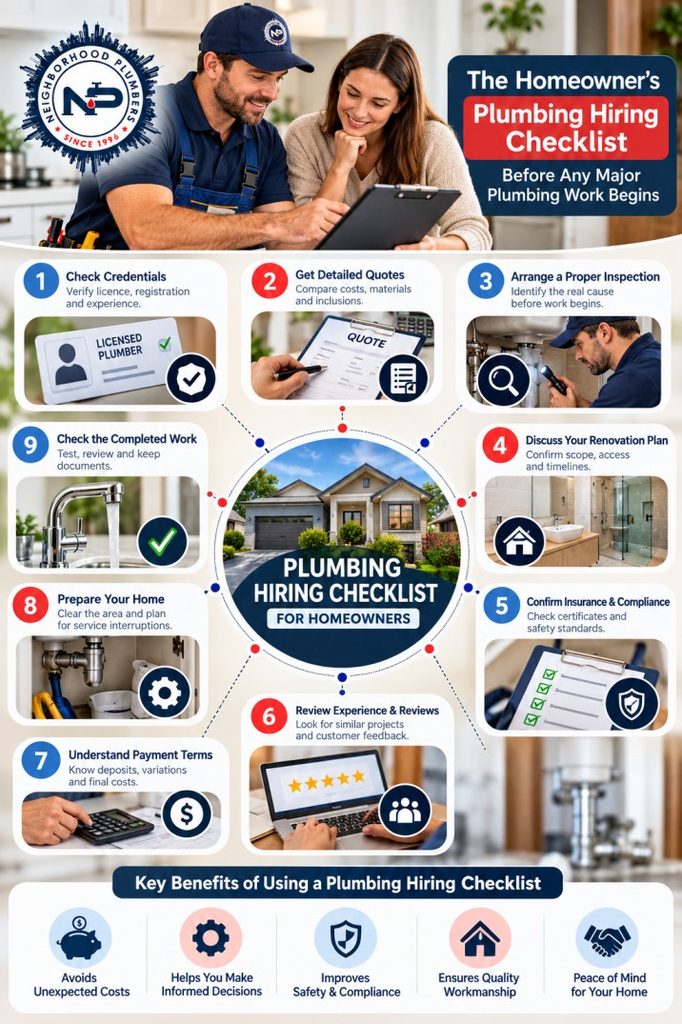
Large plumbing projects rarely involve just one decision. The homeowner may need to approve materials, discuss access arrangements, review unexpected findings and coordinate work with a builder.
Agreeing on communication arrangements before work starts can prevent avoidable misunderstandings.
Ask for one main contact who can explain progress, confirm decisions, and respond to questions about the agreed scope.
For renovation projects, clarify whether you should contact the plumber directly or communicate through the builder. This is particularly important when several trades are working on the property.
Agree on how urgent issues will be communicated and how written approvals will be recorded.
Plumbing work can be delayed by inaccessible pipework, unavailable materials, additional repairs or coordination problems.
Rather than expecting every project to proceed without changes, ask how the contractor will notify you of delays and explain their effect on the next stage of work.
For example, if a drainage repair prevents the tiler from finishing the bathroom, the builder and plumber may need to agree on a revised sequence. Early communication gives you more time to adjust arrangements.
Keep a record of important decisions, revised dates and approved variations. Clear documentation can help resolve disagreements if the project does not proceed as expected.
The hiring process does not end when the plumber packs away the tools. Before considering the job complete, make sure you understand what was done and receive the relevant documentation.
Ask the plumber to explain the completed work and demonstrate the operation of any new fixtures or appliances, where appropriate.
Your final checks may include:
A visual inspection cannot prove that concealed pipework is defect-free. Appropriate testing and compliance documentation remain important where required.
If something does not appear right, raise the concern promptly and ask the plumber to explain the next step. Keep photographs and written records of any issue.
The BPC recommends retaining quotes, agreements, invoices, photographs and related records if concerns about plumbing work arise.
Even careful homeowners can overlook important details when a leak needs urgent attention or a renovation deadline is approaching.
Avoid these common mistakes:
Choosing solely on price: A lower quote may omit materials, testing, access work, or other necessary tasks. Compare equivalent scopes before deciding.
Assuming every plumber can perform every task: Verify the practitioner’s current registration or licence and the relevant work category.
Accepting vague verbal promises: Confirm the scope, price, exclusions and variation process in writing.
Ignoring recurring symptoms: Repeated blockages, persistent dampness or fluctuating water pressure may require investigation rather than another temporary fix.
Failing to plan for disruption: Ask whether water will be unavailable, whether bathrooms can still be used, and how long the work is expected to take.
Skipping completion documents: Request any applicable compliance certificates and retain invoices, reports and product information.
Approving extras without understanding them: Ask what the additional work addresses, whether it is urgent, what alternatives exist, and how much it will cost.
Leaving everything until the final day: Confirm the installation details, access arrangements and materials before the scheduled start.
The aim is not to make the hiring process unnecessarily complicated. It is to resolve the important questions before they become expensive problems.
A few additional practices can make your selection process more effective.
If a plumber proposes replacing an entire section of pipework, ask why a smaller repair would not be suitable. The answer may involve pipe condition, accessibility, repeated failures, or the risk of disturbing adjacent connections.
A professional explanation should connect the recommended work to the evidence available.
During a renovation, you may be offered improved fixtures, new isolation valves or other upgrades. Some may provide meaningful benefits, while others may be optional.
Ask the plumber to distinguish between work needed to address the current problem, work required for compliance and optional improvements.
In older properties, existing pipe materials, previous alterations and concealed damage can affect the scope. Ask what uncertainties remain and how additional work will be priced if those conditions are discovered.
Save the quote, contract, product details, invoices, photographs, inspection findings and completion documents together. This makes it easier to check what was agreed and helps if you need future repairs.
A contractor who explains the problem clearly, answers reasonable questions and documents changes makes it easier to manage the project. Technical skill and clear communication are both valuable when work affects your home.
For homeowners comparing Plumbing Services Melbourne, these practices offer a practical way to look beyond advertising claims and focus on the quality of the proposed work.
For additional support when organising your project, Neighborhood Plumbers is a name homeowners can include in their research when comparing plumbing providers. Apply the same checks to every contractor you consider, including credentials, scope, written pricing and relevant compliance requirements.
Hiring the right plumber starts with asking the right questions. A clear Plumbing Hiring Checklist helps you verify credentials, understand the proposed work, compare quotes fairly and prepare for the practical realities of a major repair or renovation.
Before work begins, confirm the scope, pricing, schedule, safety arrangements and applicable compliance requirements. During the project, document changes and seek clear explanations when unexpected problems arise. At completion, check the work and retain the relevant records.
If you are comparing Plumbing Services Melbourne, take time to evaluate each contractor on the same criteria rather than making a decision based on price alone. Homeowners researching options such as Neighborhood Plumbers should apply these checks consistently and select a qualified professional whose approach suits the project’s requirements.
The best hiring decision is one that gives you a clear understanding of what will be done, what it will cost, how the work will be managed, and which documents you should receive when the job is finished.
Start by checking the plumber’s current registration or licence and whether it covers the proposed work. Review an itemised quote, confirm the scope and exclusions, discuss insurance and establish whether a compliance certificate is required.
For major projects, also ask about the work schedule, payment terms, access arrangements, and how unexpected repairs will be approved. Comparing at least three quotes for the same scope can help you evaluate differences in price and value.
A suitable inspection helps identify the likely cause of a plumbing problem before you commit to a repair. For example, a recurring blockage might require more investigation than another round of drain cleaning.
The appropriate inspection depends on the symptoms and proposed work. Ask the plumber what they examined, what the findings indicate, and whether further testing is needed. An inspection can reduce uncertainty, although concealed conditions may still emerge once work begins.
A compliance certificate is generally required for plumbing work valued above $750, including labour, materials, appliances and GST. Certain types of work, including specified gas-fitting work and below-ground sanitary drainage, also require a certificate regardless of cost.
Only an appropriately licensed plumber can issue the certificate. Where required, it must generally be provided to the customer within five days of completion. Check the current requirements with the Building and Plumbing Commission, particularly if your project includes specialised work.
Ask each contractor to price the same work and identify the materials, labour, testing, disposal, exclusions and potential additional charges. Check whether GST is included and whether the price is fixed or estimated.
Then compare the proposed solution, relevant experience, credentials, communication, and expected timeframe. A low quote is not automatically poor quality, just as a high quote does not guarantee better workmanship. The important question is whether the price and scope are clear and appropriate for your needs.
Start with the plumber or project manager responsible for the work. Request an explanation of the newly discovered problem, photographs where practical, the proposed solution, additional cost, and expected delay.
Review your original agreement and approve significant variations in writing. If the issue involves a wider building project, coordinate the decision with your builder. If defective work cannot be resolved directly, the BPC may be able to assess a complaint or provide information about applicable insurance arrangements. Retain your records and seek independent advice if necessary.